
What is Fascia? The Body’s Forgotten Organ
For decades, medical professionals primarily focused on bones, muscles, and nerves to understand musculoskeletal pain. However, recent scientific understanding has shifted to highlight the role of fascia, often described as the body’s “forgotten organ.”
Fascia is a continuous, three-dimensional web of connective tissue, primarily collagen, that encases every muscle fiber, muscle group, organ, bone, blood vessel, and nerve. It’s not just packaging; it’s a dynamic, sensing, and tension-regulating system.
Think of it like a full-body wetsuit or the white pith surrounding an orange. If you pull on the zipper of the wetsuit at your ankle, the tension immediately travels up to your shoulder. Similarly, fascia transmits mechanical tension throughout the body. Unlike muscle, which can actively contract, fascia is a passive structure that acts as a suspension system, maintaining structural integrity and posture.
Introducing Fascia Chains
The critical insight for pain management is the continuity principle: the fascia is not a collection of separate pieces but one single, uninterrupted sheet. This continuity led anatomists and researchers to map out distinct pathways of connected fascial tissue, known as fascia chains or myofascial meridians.
These chains are essentially lines of pull that distribute forces generated by movement or held by chronic posture. When one area in a chain becomes tight, restricted, or injured, it pulls on every other point along that line, potentially causing pain and dysfunction in distant locations.
The major fascia chains often discussed include:
- The Superficial Back Line (SBL): Runs from the bottom of the feet up the calves, hamstrings, glutes, back, and ends at the forehead.
- The Superficial Front Line (SFL): Runs from the top of the feet, up the shins, quadriceps, abdominals, chest, and neck.
- The Lateral Lines (LL): Run up the sides of the body, crisscrossing at the shoulder and hip to provide stability and balance.
The “Source” vs. The “Symptom”
The concept of fascia chains fundamentally changes how we view chronic pain, particularly in the neck and back. A hallmark of many persistent pain conditions is the failure of treatment to provide lasting relief because it focuses solely on the symptom rather than the source.
1. How Fascia Chains Explain Neck Pain
A person with chronic, persistent neck pain (cervicalgia) might receive massage, stretching, and adjustments directly to the neck muscles, yet the pain returns. The fascial perspective suggests the tension may be originating elsewhere on the Superficial Back Line (SBL) or Superficial Front Line (SFL).
- The SBL Connection: Tightness in the hamstrings or glutes can cause a posterior tilt of the pelvis. To remain upright, the upper back (thoracic spine) must round forward, which then forces the neck to hyperextend (jut the chin forward) to look straight ahead. This postural compensation creates immense, unrelenting tension on the fascia and muscles at the base of the skull (suboccipitals), leading to chronic neck stiffness and pain. The source is the pelvis and legs; the symptom is the neck.
- The SFL Connection: Overly tight hip flexors (psoas) or restricted chest fascia (from prolonged slouching/sitting) can pull the shoulders forward. This sustained anterior pull shortens the SFL, forcing the neck muscles to constantly work against this downward, forward tension.
2. The Back Pain Puzzle
Back pain, particularly in the lower back (lumbar region), is often directly linked to imbalances in the Lateral Lines (LL) and the deep core stabilizers, which are encased in the thoracolumbar fascia.
- The Foot-to-Back Connection: People with flat feet (pronation) or those who compensate for an old ankle injury often unconsciously shift their weight to one side. This chronic imbalance creates a side-to-side tension pattern along the Lateral Line of the body. The resulting strain is transmitted up to the hip, causing the pelvis to shift, and ultimately creating chronic, asymmetrical tension in the lower back muscles, leading to persistent, nagging back pain.
- The Thoracolumbar Fascia: This thick sheet of fascia in the low back is a central hub for multiple chains. Dysfunction here is often the result of insufficient core stabilization, causing the back to rely on the fascial structure for support, leading to micro-tears and chronic inflammation.
The Surprising Link to Headaches
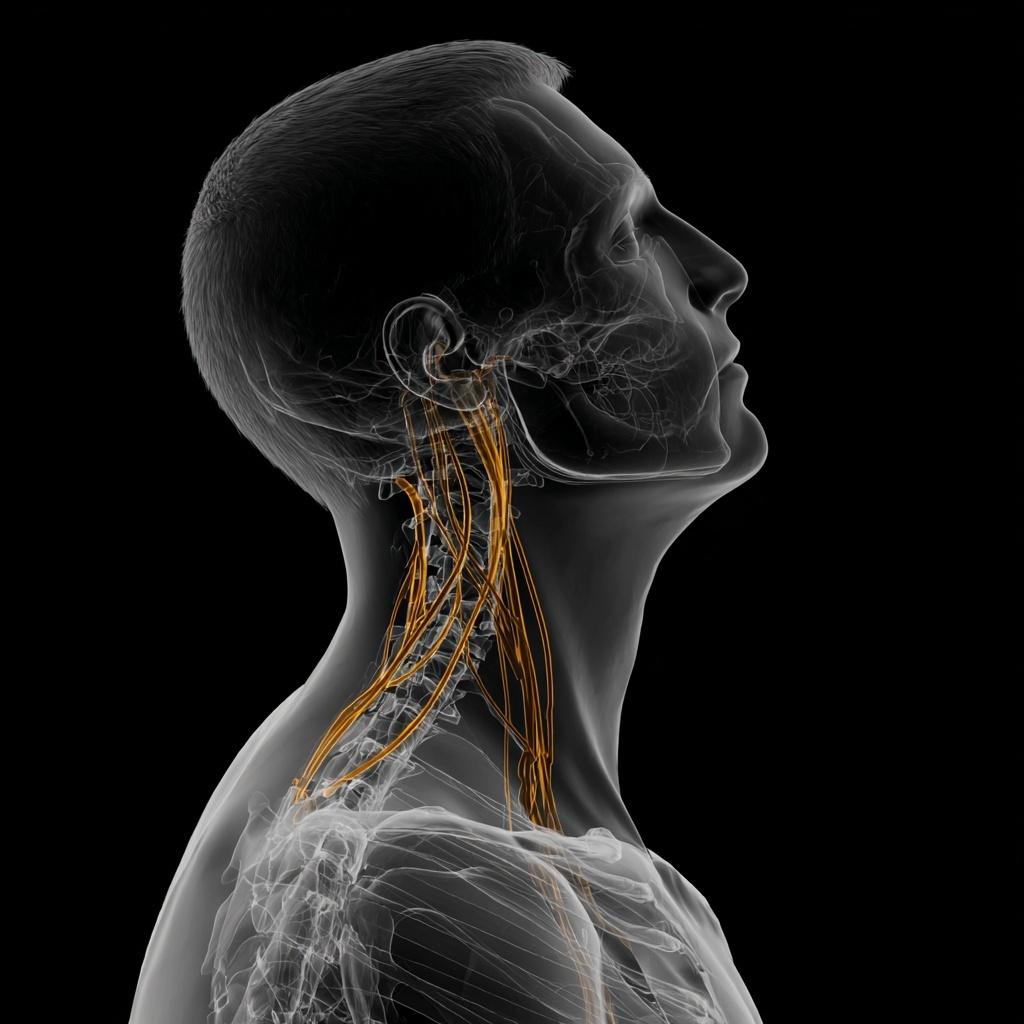
Perhaps the most surprising, yet compelling application of the fascia chain model is its ability to explain certain types of chronic headaches, specifically tension headaches and cervicogenic headaches (those originating from the neck).
The Superficial Back Line ends at the galea aponeurotica (the fascial sheet covering the top of the skull) and the muscles at the base of the neck. When the entire SBL is tight, from a restricted calf or a tight upper back, the tension is ratcheted up the spinal column.
This tension culminates in the suboccipital muscles (small muscles connecting the base of the skull to the top vertebrae). These muscles are enveloped in a dense layer of fascia that is also neurologically connected to the dura mater (the tough membrane surrounding the brain and spinal cord). When the suboccipitals become chronically tight due to the pull of the entire back chain, they can irritate nearby nerves and literally pull on the fascial layers surrounding the skull and brain, causing a radiating, vice-like pain often described as a tension headache.
Therefore, treating the headache might require releasing the tension not in the head, but in the upper back, shoulders, or even the hamstrings, which are the originating point of the excessive pull.
A Holistic Treatment Approach
Recognizing the interconnectedness of fascia chains necessitates a shift in treatment philosophy from isolated muscle treatment to a holistic, whole-body approach.
- Myofascial Release (MFR): This specialized technique involves applying sustained pressure to fascial restrictions to help lengthen and release the hardened tissue. Unlike traditional massage, MFR holds the pressure for longer periods (30 seconds to several minutes) to allow the viscous, connective tissue to release its grip and restore fluidity.
- Structural Integration (Rolfing): This method explicitly follows the lines of the fascia chains over a series of sessions, systematically releasing and re-educating the body’s structure to achieve better alignment and long-term postural balance.
- Functional Movement and Yoga: Practices that focus on full-chain, multi-joint movements, rather than isolated stretching, are key. For instance, instead of stretching just the hamstring, movements that coordinate hip, back, and neck extension (like certain yoga flows) ensure that the entire chain is being lengthened and re-integrated functionally.
- Hydration and Nutrition: Fascia relies on hydration to maintain its flexible, gliding nature. Chronic dehydration can cause the fascial layers to stick together (cross-linking), leading to restrictions and a feeling of stiffness.