
Hands on treatment tends to be the part of physiotherapy people remember. It is tangible, it happens in the room, and it often produces some immediate change in how movement feels. That immediacy can make it seem like the whole of treatment, when in practice it is usually one component within a broader plan.
Manual therapy is best understood as a set of skilled techniques that a clinician selects after assessment, alongside movement work, education and exercise. Those elements serve different purposes, and the balance between them depends on the person, the presentation and the goals being worked toward. Understanding which part does what makes it easier to judge whether a plan is suited to the problem in front of it.
What Manual Therapy Involves
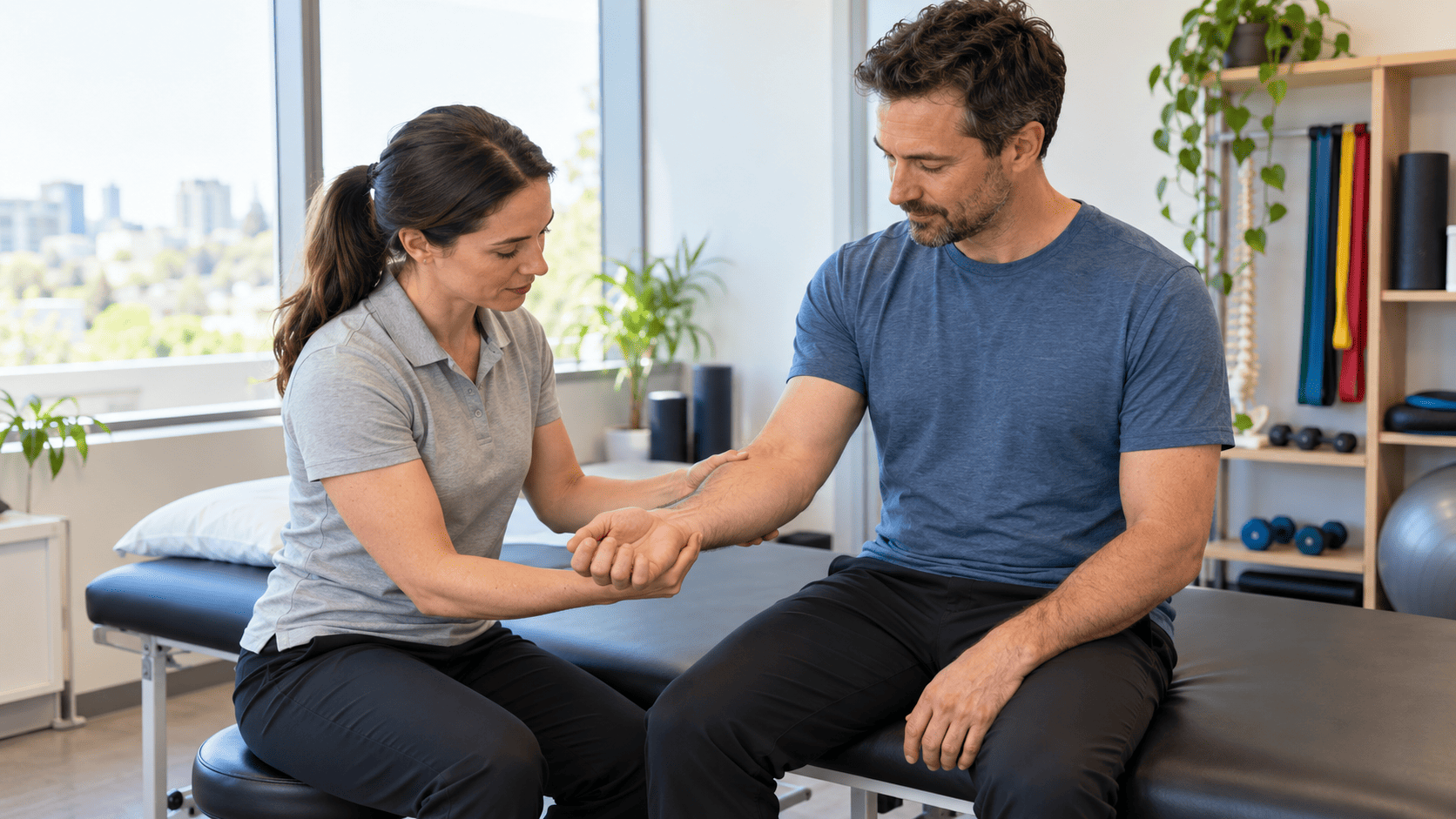
Manual therapy describes hands-on techniques used to assess and treat musculoskeletal conditions. The category covers a range of approaches rather than a single method, and the terminology is worth unpacking because the distinctions matter when discussing a plan.
Joint mobilisation refers to gentle, controlled movement applied to a joint within or near its available range. It is typically graded, meaning the clinician adjusts the intensity and amplitude of the movement. Joint manipulation involves a faster, smaller amplitude movement, often producing the audible pop that people associate with chiropractic or manual therapy treatment. Soft tissue techniques address muscle, tendon, ligament and fascia through methods such as myofascial release, trigger point work and various forms of massage. Neural mobilisation, sometimes called nerve gliding, addresses tissue that may be sensitive or mechanically restricted along a nerve pathway.
These techniques are applied with a purpose that goes beyond the sensation they produce. They may be used to improve how a joint moves, to reduce the sensitivity of tissue that has become protective, or to create a window in which movement and loading feel more manageable. Some of the effects are mechanical. Some relate to how the nervous system responds to the input.
One important qualifier: no single technique suits every person or every presentation. A method that helps one shoulder may be inappropriate for another, and the same approach applied at the wrong stage can be counterproductive. This is why technique selection follows assessment rather than preceding it, and why a clinician’s reasoning matters more than the specific label applied to the technique.

How Assessment Guides Treatment Choices
The assessment is where the plan begins, and it usually covers more ground than the location of the pain. A clinician will typically consider the history, the pattern of symptoms, how movement behaves, what strength and control look like, and how the problem affects daily life. The question is not simply where it hurts, but what is contributing to the difficulty and what might reasonably change it.
Symptom behaviour offers useful information. A problem that eases with movement behaves differently from one that worsens with it, and symptoms that change with position or load point in particular directions. Ruling out presentations that require a different pathway, such as a medical review, is part of this process.
Movement findings come next. Range of motion, quality of movement, joint behaviour, muscle strength and control all feed into the picture. So do preferences and context. Someone who cannot tolerate lying on a treatment table comfortably, or who finds certain positions distressing, needs a different starting point. Someone training for a specific event has different priorities from someone managing a long standing ache.
Suitability is assessed honestly. There are presentations where manual therapy is unlikely to be the most useful component, and a clinician should be able to explain that rather than applying hands on treatment by default. There are also situations where a person would rather focus on exercise and self management, and that preference is a legitimate input into the plan.
Where manual therapy is included, it is usually because the assessment suggests it may provide a useful opening, whether that means reducing sensitivity enough to allow movement practice, changing how a joint behaves, or supporting a loading programme that is proving difficult to progress. Advanced manual therapy treatment of this kind is one option a qualified physiotherapist may recommend following assessment, and the specific techniques chosen should reflect the individual case rather than a standard protocol.
Combine Hands On Care With Active Rehabilitation
The evidence on this point has become clearer over time. Manual therapy alone tends to produce short term effects, and combining it with exercise and education is generally associated with better outcomes than hands on treatment in isolation.
That finding shapes how a plan is built. Exercise does the work of building capacity: strength, endurance, control and tolerance for load. Those qualities are what allow a person to return to lifting, running, commuting or gardening, and they develop over weeks rather than in a single session. Hands-on techniques cannot substitute for that adaptation.
Education serves a different function. Understanding what is happening, what is safe, and how progress is expected to look reduces the uncertainty that often accompanies pain. It also helps a person interpret setbacks without assuming the worst. For many presentations, particularly persistent ones, that understanding is a significant part of improvement.
Self management extends the plan beyond the treatment room. Exercises done between sessions, activity modifications and pacing strategies are what carry progress through the week. A plan that depends entirely on clinic visits has limited reach.
This is also where the value of manual therapy can be understood most clearly. Its contribution is often enabling, creating conditions in which movement and loading become tolerable enough to progress. That is a valuable role, and describing it accurately is more useful than claiming it does the work of rehabilitation on its own.

Apply the Plan to Daily Life in Downtown Toronto
A rehabilitation plan only matters insofar as it changes what someone can do. For many people, the relevant activities are not sporting ones. They are a commute, a workstation, a walk at lunch, and the ordinary demands of a long day.
Desk work is a common example. Hours in a sustained position can leave the neck, shoulders and lower back feeling stiff, and a plan may include ways to break up that time, adjust the setup, and build tolerance for the postures the day requires. Hands on treatment may help with an acute flare, but the daily pattern is what shapes the ongoing picture.
Commuting adds its own load. Standing on a crowded train, carrying a bag on one shoulder, walking between stations and navigating stairs all place demands on the body. Someone recovering from a lower limb or back issue may find that the commute is the hardest part of the day, which makes it worth discussing directly rather than treating it as separate from rehabilitation.
Walking and recreation fill in the rest. A loop through a local park or along a favourite route on a lunch break is a reasonable measure of tolerance, and progress in that context is meaningful. So is a return to a weekend activity that has been set aside. These goals tend to be more motivating than abstract markers.
Progress should be reviewed rather than assumed. Symptoms change, capacity changes, and a plan that suited the first few weeks may not suit the next few. Reviewing at intervals, checking whether the exercises are still appropriate and adjusting the balance between hands on work and active training keeps the plan aligned with what is actually happening. If progress stalls, that is information to act on, and the clinician should be able to explain what the next step is and why.
An Individual Plan, Reviewed Over Time
Manual therapy has a legitimate place in physiotherapy, and it is most useful when it sits within a plan built around movement, exercise, education and self management. The techniques are selected after assessment, applied where they serve a clear purpose, and adjusted as the picture changes.
What matters most is that the plan fits the person. Two people with similar symptoms may need quite different approaches, and the reasoning behind those choices is worth asking about. A plan that is explained, reviewed and adjusted as progress unfolds tends to serve people better than one applied by default, whatever techniques it includes.
Frequently Asked Questions
What is the difference between manual therapy and a broader physiotherapy plan?
Manual therapy covers the hands-on techniques a clinician uses, such as joint mobilisation, manipulation and soft tissue work. A broader physiotherapy plan includes those techniques where appropriate, alongside exercise, education, activity modification and self management strategies. Manual therapy is one component of a plan rather than the plan itself.
Is manual therapy suitable for every type of pain?
No. Suitability depends on the presentation, the stage of recovery and the individual. Some conditions respond well to hands-on treatment, while others are better addressed primarily through exercise and education. A clinician should be able to explain why a particular technique is being considered and what it is expected to contribute.
Why might exercises be included alongside hands on treatment?
Exercise builds the strength, endurance and control that allow someone to return to their activities, and those changes develop over weeks. Hands-on techniques tend to produce shorter term effects, and combining the two is generally associated with better outcomes than either approach alone.
How should progress be reviewed during rehabilitation?
Progress is usually reviewed at intervals, looking at symptoms, movement, capacity and how daily activities are going. The plan can then be adjusted, whether that means changing exercises, altering the balance of hands on work, or moving toward more challenging activity. If progress stalls, that should prompt a review rather than repetition of the same approach.