
Most people who notice their hairline pulling back or a patch thinning at the crown assume it’s stress, or maybe genetics, and leave it at that. But that explanation skips over something important — the actual biological mechanism happening inside your scalp. And until you understand that, it’s hard to make sense of why some treatments work and others don’t.
The truth is, a large majority of pattern hair loss cases, both in men and women, trace back to a single hormone. Not thyroid. Not cortisol. A hormone called DHT.
What DHT Actually Is
DHT stands for dihydrotestosterone. It’s not a separate hormone your body produces independently — it’s made from testosterone through a conversion process driven by an enzyme called 5-alpha reductase. This enzyme is found in several tissues throughout the body, including the skin and scalp.
The conversion happens naturally and continuously. DHT itself isn’t harmful in most contexts. It plays a legitimate role in male development, particularly during puberty. The problem shows up specifically at the level of the hair follicle, and only in people who have a certain genetic sensitivity to it.
How DHT Damages Hair Follicles
Hair follicles have receptors on them. In people with androgenetic alopecia — the clinical name for pattern baldness — certain follicles carry receptors that are unusually sensitive to DHT. When DHT binds to these receptors, it triggers a process called follicular miniaturization.
Here’s what that looks like in practice:
- The growth phase of the hair cycle (called anagen) shortens with each cycle
- Hairs grow back thinner and shorter over time
- Eventually, the follicle shrinks to a point where it can only produce fine, colorless vellus hair — the kind barely visible to the naked eye
- After repeated cycles of this, the follicle may stop producing hair entirely
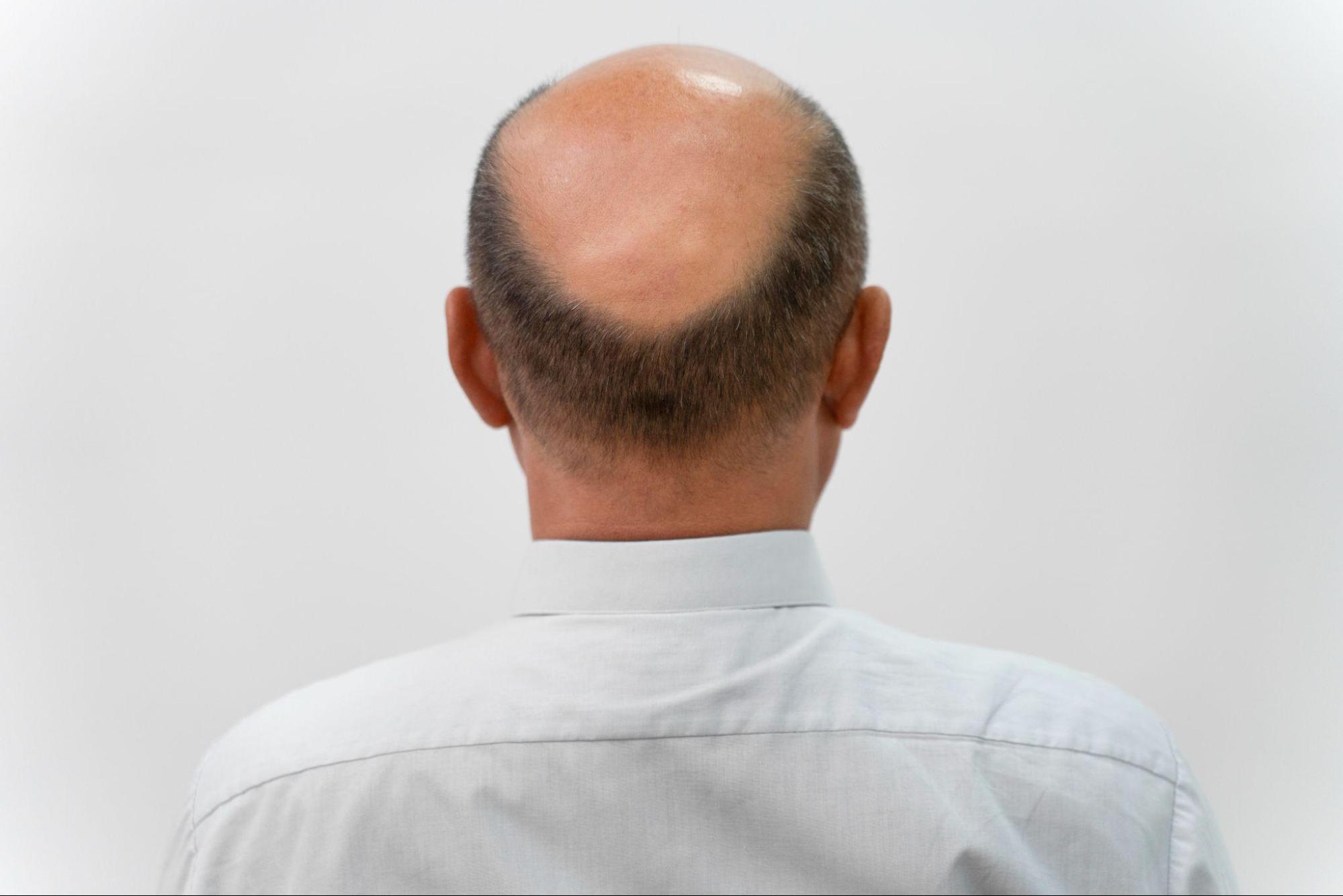
The reason this shows up in specific patterns — receding temples, thinning crown — is that follicles in those zones tend to carry more of these sensitive receptors. Follicles at the back and sides of the scalp are largely unaffected, which is why hair remains there even in advanced cases. This is also why hair transplants source grafts from the back of the head.
Why Some People Are Affected and Others Aren’t
Two people can have identical DHT levels and end up with completely different outcomes. One might have a full head of hair at 50; the other might start losing it in their early 20s. The deciding factor is receptor sensitivity, which is genetically determined.
This is why the phrase “it runs in the family” is actually accurate when it comes to pattern hair loss. You can inherit this sensitivity from either side of the family. The old idea that baldness is only passed through the maternal grandfather has been largely disproven — the genetics are more complex and multi-factorial than that.
What’s worth understanding is that DHT isn’t the villain. Your body is doing exactly what it’s supposed to do. The issue is how certain follicles respond to it. This distinction matters because it shifts the focus from lowering DHT broadly — which can have side effects — to targeting the interaction at the follicle level.
What the Research and Treatments Focus On
Most clinically validated treatments for androgenetic alopecia work by interfering somewhere in the DHT-follicle relationship. Finasteride, for example, inhibits the 5-alpha reductase enzyme, reducing DHT production. Minoxidil works differently — it doesn’t target DHT at all but helps prolong the growth phase of affected follicles.
Understanding the role of dht in hair loss is especially important before starting any treatment, because the stage of follicle damage matters enormously. A follicle that’s miniaturized but still active can often respond to treatment. One that’s been dormant for years has a much lower chance of recovery.
This is an area where Traya’s diagnostic approach is worth noting — their model focuses on identifying the root cause of hair loss before recommending a course of treatment, rather than applying a one-size-fits-all solution.
Final Thoughts
Pattern baldness isn’t random. It follows a biological logic driven primarily by DHT and follicular sensitivity. Understanding this doesn’t just satisfy curiosity — it helps you ask better questions, evaluate treatments more critically, and avoid wasting time on things that don’t address the actual problem. The more clearly you understand what’s happening at the root, the better your decisions will be about what to do next.