
For millions of men and women experiencing androgenetic alopecia, modern surgical hair restoration—utilizing Follicular Unit Extraction (FUE) or Direct Hair Implantation (DHI)—provides a permanent, natural-looking solution. However, achieving superior cosmetic density depends on much more than the surgeon’s skill during extraction and incision creation. The long-term success of any hair transplant is deeply rooted in human follicular biology and the complex physiological stages of graft survival.
Understanding the cellular journey of transplanted follicles allows prospective patients to set realistic expectations, maintain proper post-operative compliance, and navigate the recovery journey with confidence.
The Cellular Biology of Graft Integration: Ischemia and Neovascularization
When a hair follicle is harvested from the androgen-resistant donor zone (typically the occipital region at the back of the scalp), it is temporarily severed from its primary blood supply. Once re-implanted into the recipient site, a critical biological race against ischemic tissue damage begins.
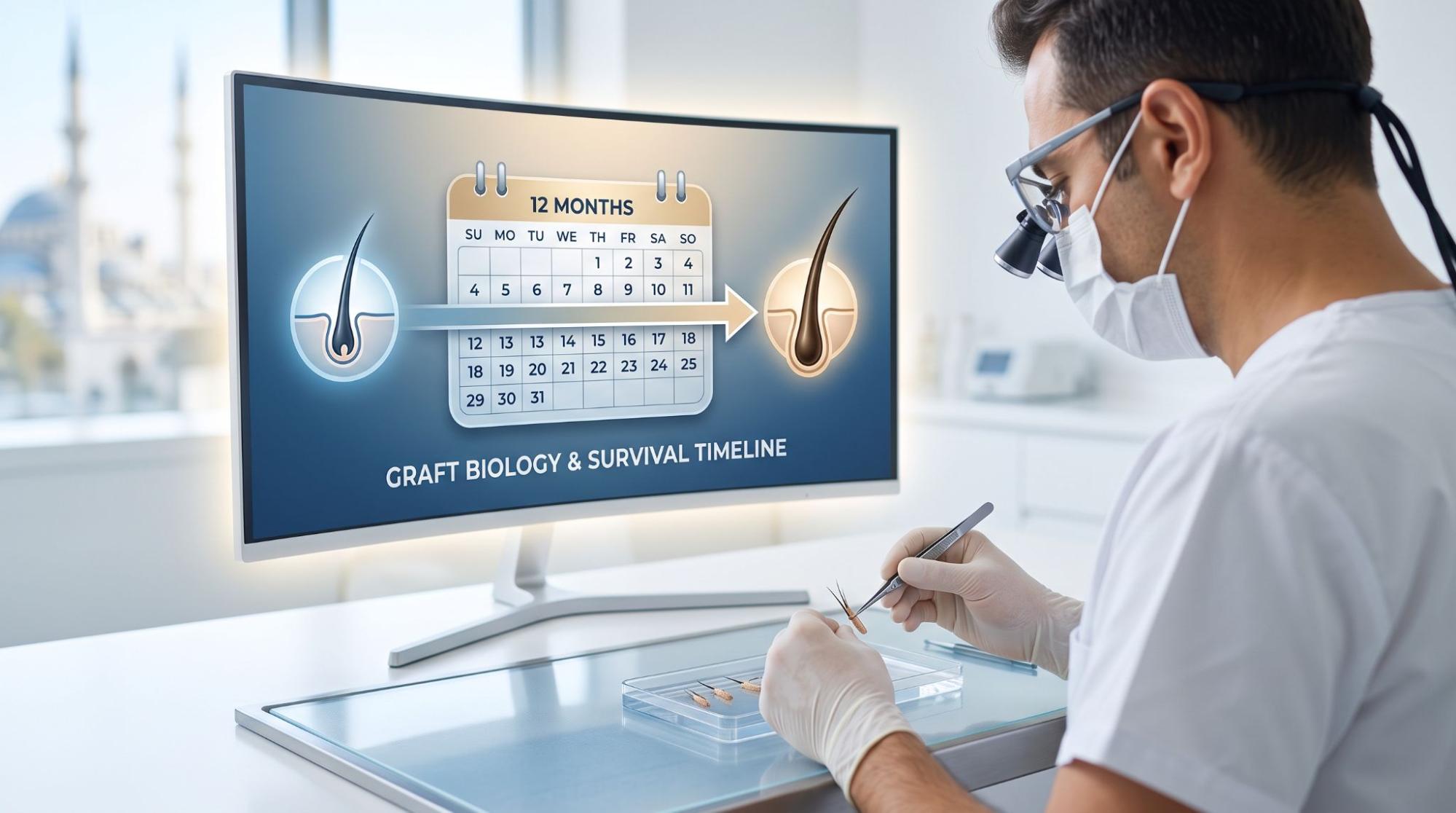
During the initial 72 hours post-surgery, transplanted grafts survive through a mechanism known as plasmatic imbibition—absorbing essential nutrients and oxygen purely from surrounding interstitial tissue fluid. Within 48 to 7 days, micro-vascular connections (neovascularization) begin to re-establish, connecting the follicle back to the body’s systemic blood circulation.
According to clinical research published by the National Institutes of Health (NCBI), transplanted hair follicles naturally enter a protective resting phase following surgical trauma, causing the visible hair shaft to shed while the underlying dermal papilla remains fully viable beneath the skin.
This temporary shedding phase—often referred to as “shock loss”—typically occurs between weeks 2 and 6 post-operation. While it can cause temporary concern for patients, it is a completely normal physiological reaction. The follicle root remains intact, preparing its metabolic machinery to initiate a new, permanent anagen (growth) phase.
Chronological Growth Progression: What to Expect Month by Month
Patience is a fundamental requirement in hair restoration surgery. Because human hair grows at an average rate of 1 to 1.5 centimeters per month, visual changes occur gradually over an extended timeframe rather than overnight.
The standard visual recovery timeline generally unfolds across four key biological stages:
- Months 1 to 3 (The Dormant Phase): Post-surgical redness and minor inflammation subside. The majority of transplanted shafts shed, and the follicles establish deep vascular anchors within the dermal layer.
- Months 4 to 6 (Initial Emergence): Fine, unpigmented hairs begin to breach the scalp surface. Early growth may appear sporadic, fine, or slightly texturally altered as the new shaft matures.
- Months 7 to 9 (Density Amplification): Hair shafts undergo rapid thickening (caliber expansion), gain natural pigmentation, and provide noticeable visual coverage across the hairline or crown.
- Months 10 to 12 (Maturation & Final Density): The vast majority of patients achieve their final visual result by the one-year mark, featuring full cosmetic density and seamless integration with existing native hair.
To follow the detailed biological evolution month by month and track key recovery benchmarks, reviewing the TurkHairIndex step-by-step post-operative recovery guide offers essential insights into what patients should expect at every phase of the healing journey.
Key Biological Factors Influencing Graft Yield
While patient physiology plays a significant role in healing, several clinical and post-operative factors directly impact final graft survival rates:
- Out-of-Body Time & Holding Solutions: Minimizing the time grafts spend outside the body and keeping them hydrated in chilled holding solutions (such as HypoThermosol or saline) prevents cellular apoptosis.
- Scalp Hygiene & Scab Management: Gentle washing protocols starting on day 3 help eliminate crusting and minimize the risk of localized folliculitis without dislodging fragile grafts.
- Vascular Health & Lifestyle Compliance: Avoiding nicotine, strenuous physical exercise, and direct sun exposure during the first 14 days preserves micro-vascular blood flow to the newly implanted roots.
Conclusion
Hair restoration is a harmonious blend of surgical artistry and human dermatological physiology. By understanding the underlying cellular cycle of hair grafts and adhering strictly to post-operative guidelines, patients can navigate their recovery timeline with peace of mind and achieve lasting, natural-looking hair density.