
Pain along the thumb side of the wrist often begins as a minor inconvenience. You may notice a sharp discomfort when opening a jar, lifting a shopping bag, turning a doorknob, or picking up a child. Initially, the pain may disappear after resting your hand. However, for some people, the discomfort gradually becomes more frequent, eventually interfering with activities that previously required little effort.
One possible explanation is De Quervain tenosynovitis, a condition affecting two tendons that control thumb movement. Although many people recover with appropriate treatment, others experience persistent symptoms lasting several months or longer.
This raises an important question: Can De Quervain tenosynovitis become chronic, and what happens when the pain does not improve?
The answer is yes. De Quervain tenosynovitis can become a persistent or recurrent condition, particularly when the affected tendons continue to experience mechanical irritation or when narrowing of the surrounding tendon compartment prevents smooth movement.
However, chronic De Quervain tenosynovitis does not necessarily mean permanent damage or lifelong wrist pain. Understanding why symptoms persist, recognizing the signs of worsening tendon irritation, and choosing appropriate treatment can significantly improve the chances of recovery.
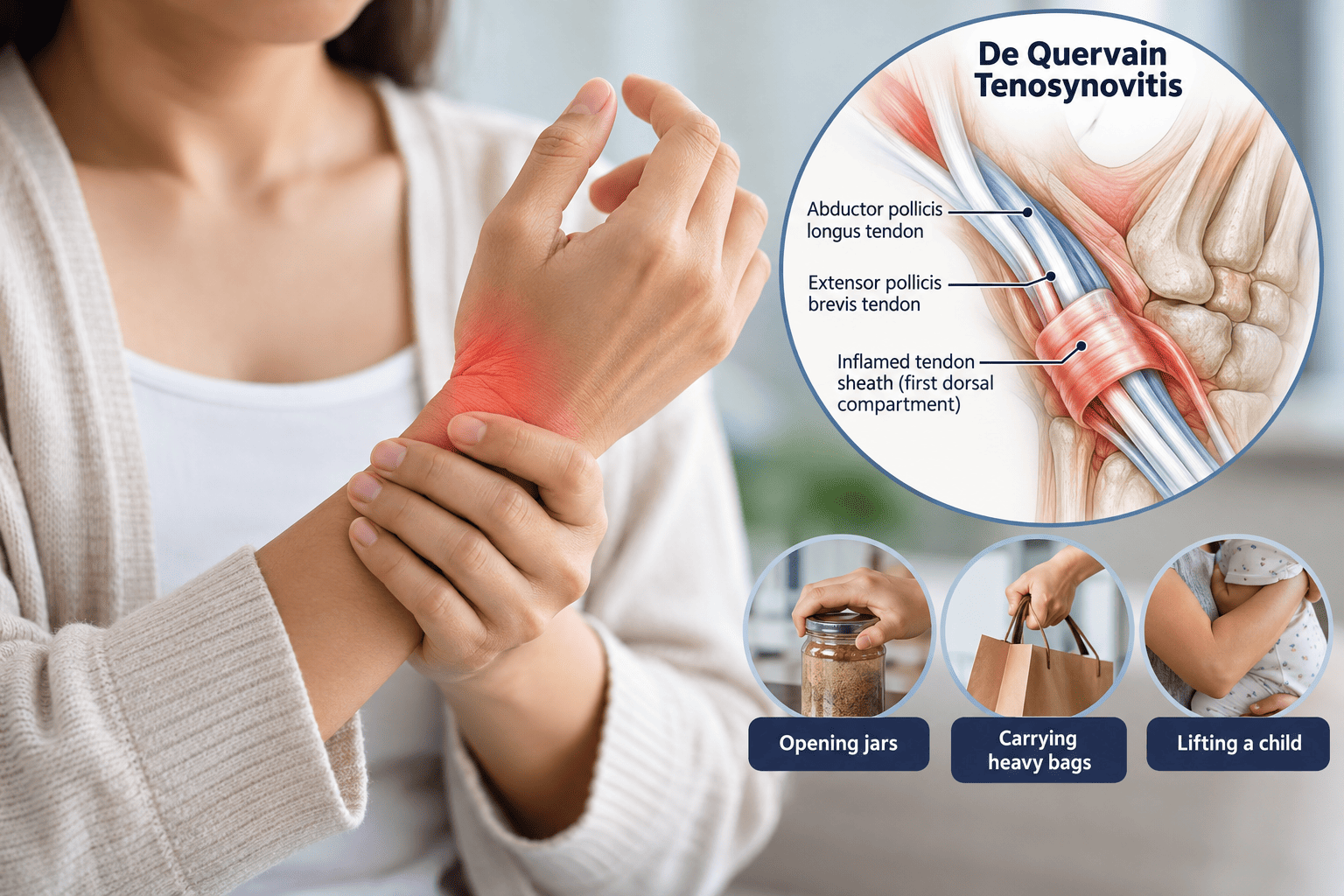
What Happens Inside the Wrist When De Quervain Tenosynovitis Develops?
To understand why De Quervain tenosynovitis sometimes becomes chronic, it helps to look at the structures responsible for thumb movement.
Two important tendons travel along the thumb side of the wrist:
- Abductor pollicis longus: Helps move the thumb away from the hand.
- Extensor pollicis brevis: Helps straighten the thumb.
These tendons pass through a narrow passage called the first dorsal compartment, located near the radial styloid, the bony prominence on the thumb side of the wrist.
Under normal circumstances, the tendons glide smoothly through this compartment as the thumb and wrist move.
In De Quervain tenosynovitis, the tissue surrounding the tendons becomes thickened, reducing the available space within the compartment.
This narrowing can interfere with tendon gliding and produce pain during thumb movement, gripping, lifting, or wrist deviation.
Although the condition is commonly described as tendon inflammation, research suggests that degenerative changes, fibrous thickening, and narrowing of the tendon sheath also play important roles.
These structural changes help explain why symptoms may persist even after the initial irritation has subsided. (1)
Can De Quervain Tenosynovitis Become a Chronic Condition?
Yes. De Quervain tenosynovitis can become chronic when symptoms continue despite rest, activity modification, splinting, or other conservative treatments.
There is no universally accepted duration that separates acute De Quervain tenosynovitis from chronic disease.
In clinical practice, symptoms lasting several months, repeatedly returning after temporary improvement, or causing ongoing functional limitations may be described as persistent or chronic De Quervain tenosynovitis.
The condition may follow different patterns.
Persistent De Quervain Tenosynovitis
Some individuals experience continuous pain along the thumb side of the wrist.
Symptoms may fluctuate throughout the day but never completely disappear.
Activities involving gripping, lifting, or repetitive thumb movement often make the pain worse.
Recurrent De Quervain Tenosynovitis
Other individuals improve with treatment but experience another episode weeks or months later.
For example, someone may notice substantial improvement after wearing a wrist splint, only to develop pain again after returning to repetitive lifting or prolonged hand-intensive activities.
Progressive De Quervain Tenosynovitis
In certain cases, symptoms gradually become more severe.
Initially, pain may occur only during specific movements. Later, everyday activities such as holding a cup, fastening clothing, or turning a key may become uncomfortable.
Some individuals also develop increasing tenderness, swelling, or difficulty moving the thumb.
Importantly, persistent symptoms do not automatically indicate irreversible tendon damage. Most patients can still benefit from appropriate treatment, including surgical release when conservative measures are unsuccessful. (1, 2)
Why Does De Quervain Tenosynovitis Sometimes Refuse to Heal?
Several factors can contribute to persistent thumb-side wrist pain.
Understanding these factors is particularly important when symptoms continue despite treatment.
1. Repetitive Thumb and Wrist Movements Continue to Irritate the Tendons
One common reason for prolonged symptoms is continued exposure to movements that aggravate the affected tendons.
These may include:
- Repeated gripping or pinching.
- Lifting objects with the wrist bent.
- Frequent twisting of the wrist.
- Repetitive thumb movements during work.
- Carrying heavy bags.
- Lifting infants or young children.
- Activities requiring sustained thumb pressure.
For example, a person who repeatedly lifts boxes at work may continue irritating the first dorsal compartment despite wearing a splint outside working hours.
Similarly, someone caring for an infant may find it difficult to avoid lifting movements that place pressure on the thumb-side wrist.
Repetitive movement is not the only cause of De Quervain tenosynovitis, and the condition can develop without an obvious history of overuse. Nevertheless, repeated aggravation can make symptom control more difficult.
2. Thickening of the Tendon Sheath Creates Persistent Mechanical Restriction
One important feature of chronic De Quervain tenosynovitis is narrowing of the compartment surrounding the affected tendons.
As the tendon sheath becomes thicker, the available space for tendon movement decreases.
Even when inflammation improves, the tendons may continue encountering resistance as they move through the narrowed compartment.
This can explain why some individuals experience persistent pain despite reducing their activities.
Research examining the condition has identified fibrotic thickening and degenerative changes within the tendon sheath, suggesting that chronic symptoms involve more than inflammation alone. (1)
3. Anatomical Differences Within the First Dorsal Compartment
Not everyone has exactly the same tendon anatomy.
In some individuals, the first dorsal compartment contains an internal partition, or septum, separating the abductor pollicis longus and extensor pollicis brevis tendons.
This anatomical variation can influence treatment.
For example, a corticosteroid injection may reach one portion of the compartment without adequately treating the other.
A study investigating first dorsal compartment anatomy found that septation was common among patients undergoing surgery for symptomatic De Quervain disease.
These findings suggest that anatomical variations may contribute to persistent symptoms and incomplete responses to treatment. (3)
4. Inadequate Immobilization of the Thumb and Wrist
Resting the wrist does not necessarily mean the affected tendons are adequately protected.
A standard wrist brace may limit wrist movement while allowing considerable thumb motion.
Because De Quervain tenosynovitis involves tendons responsible for thumb movement, a brace that does not appropriately support the thumb may provide insufficient relief.
A thumb spica splint is commonly used because it restricts selected movements of both the thumb and wrist.
However, immobilization must be balanced with maintaining appropriate movement and avoiding unnecessary prolonged stiffness.
Research suggests that combining thumb spica immobilization with corticosteroid injection can improve treatment outcomes compared with either approach alone. (2)
5. Treatment Was Started After Symptoms Had Become Established
Some individuals continue using the affected hand for months before seeking medical evaluation.
During this period, pain may become more frequent, and compensatory movement patterns may develop.
Although delayed treatment does not guarantee a poor outcome, established symptoms may require a more structured treatment approach.
A clinician may need to reassess the diagnosis, identify aggravating activities, evaluate tendon anatomy, and consider treatments beyond simple rest.
6. Another Wrist Condition Is Contributing to the Pain
Not all persistent pain near the base of the thumb is caused by De Quervain tenosynovitis.
Conditions such as thumb carpometacarpal joint arthritis, intersection syndrome, and superficial radial nerve irritation can produce overlapping symptoms.
If the original diagnosis is incomplete or incorrect, treatment directed only at De Quervain tenosynovitis may provide little improvement.
This is one reason persistent symptoms deserve reassessment rather than repeated treatment without reviewing the underlying diagnosis.
What Are the Signs That De Quervain Tenosynovitis Is Becoming Chronic?
The symptoms of chronic De Quervain tenosynovitis are generally similar to those of the acute condition.
However, they may become more persistent, occur during less demanding activities, or interfere more significantly with daily functioning.
Persistent Pain Along the Thumb Side of the Wrist
The most characteristic symptom is pain near the radial styloid.
The discomfort may feel sharp during movement or develop into a persistent aching sensation.
Some individuals experience pain extending toward the thumb or slightly upward into the forearm.
Pain is often aggravated by gripping, lifting, twisting, or moving the wrist toward the little finger.
Tenderness Over the First Dorsal Compartment
Pressing over the thumb-side wrist may reproduce the familiar pain.
Tenderness is often concentrated near the tendons of the abductor pollicis longus and extensor pollicis brevis.
In chronic cases, even relatively light pressure may be uncomfortable.
Swelling or Thickening Near the Base of the Thumb
Some individuals notice localized swelling or fullness along the thumb side of the wrist.
The area may feel thicker than the corresponding region on the opposite wrist.
However, visible swelling is not always present.
Pain During Gripping and Pinching
Activities requiring coordinated thumb and finger movement may become difficult.
Examples include holding a pen, opening a bottle, fastening buttons, or lifting cookware.
The hand may feel weaker because pain discourages forceful gripping.
This does not necessarily indicate permanent muscle weakness.
Stiffness After Rest
Some individuals notice that the thumb and wrist feel particularly uncomfortable after remaining inactive.
Movement may initially feel restricted or painful.
Although stiffness can accompany De Quervain tenosynovitis, prominent morning stiffness affecting several joints may suggest another condition requiring evaluation.
Clicking or Catching Sensations
Occasionally, tendon movement through the narrowed compartment may produce a catching or snapping sensation.
Persistent clicking should be assessed because other tendon and joint disorders can cause similar symptoms.
What Happens If Chronic De Quervain Tenosynovitis Is Left Untreated?
Untreated De Quervain tenosynovitis does not inevitably lead to permanent disability.
Some cases improve with reduced aggravating activity.
However, persistent symptoms can create several practical problems.
Increasing Difficulty With Everyday Hand Movements
One of the most significant consequences is reduced hand function.
Tasks that require thumb stabilization may become uncomfortable.
A person may begin avoiding activities such as carrying groceries, preparing meals, writing, or using household tools.
Over time, these limitations can affect independence and quality of life.
Reduced Grip Strength Due to Pain
The thumb plays an important role in gripping and pinching.
When thumb movement produces pain, individuals may unconsciously reduce the force they apply.
This can create the impression of weakness.
In many cases, the reduced strength is related to pain and protective movement rather than direct injury to the muscles.
Compensatory Movement Patterns
People experiencing chronic wrist pain often change how they use their hands.
They may rely more heavily on the opposite hand, alter their grip, or avoid certain wrist positions.
These adjustments may reduce immediate discomfort but can make routine activities less efficient.
Persistent Tendon Sheath Thickening
Chronic De Quervain tenosynovitis may involve continued narrowing of the first dorsal compartment.
When mechanical restriction remains significant, symptoms may persist despite reduced inflammation.
In such situations, treatment aimed at reducing tendon irritation alone may not provide sufficient relief.
Effects on Work and Daily Activities
Individuals whose occupations require frequent hand movement may experience difficulty performing their usual duties.
Examples include healthcare workers, caregivers, mechanics, hairdressers, manual laborers, and individuals performing repetitive hand-intensive tasks.
The impact depends on symptom severity, job requirements, and the ability to modify activities.
Does chronic De Quervain tenosynovitis cause permanent tendon damage?
Not necessarily.
Persistent symptoms do not mean that the tendons will inevitably rupture or become permanently damaged.
Tendon rupture is not a typical consequence of untreated De Quervain tenosynovitis.
Nevertheless, ongoing pain and functional limitations warrant medical assessment, particularly when symptoms fail to improve with appropriate treatment.
How Long Does De Quervain Tenosynovitis Take to Heal?
Recovery time varies considerably.
Some individuals experience meaningful improvement within several weeks of appropriate treatment.
Others require several months, particularly when symptoms have been present for a long time or when repetitive aggravating activities cannot be avoided.
There is no reliable timeline that applies to every patient.
Recovery depends on factors such as:
- Severity and duration of symptoms.
- Degree of tendon sheath narrowing.
- Occupational and recreational activities.
- Presence of anatomical variations.
- Response to immobilization.
- Response to corticosteroid injection.
- Presence of other wrist or thumb conditions.
A systematic review and network meta-analysis involving 30 studies and 1,663 patients found that combining corticosteroid injection with thumb spica immobilization was associated with improved pain and functional outcomes. (2)
The review identified three to four weeks of thumb spica immobilization following injection as a potentially effective initial treatment strategy. (2)
However, improvement in pain does not always mean that the wrist is immediately ready for unrestricted repetitive or heavy activity.
Returning to demanding movements too quickly may aggravate symptoms.
Why Does De Quervain Tenosynovitis Sometimes Return After Treatment?
Recurrence is an important concern for people who initially improve but later experience another episode of thumb-side wrist pain.
Several explanations are possible.
The original tendon irritation may not have completely resolved.
Repetitive movements may have resumed before the wrist could tolerate them comfortably.
Anatomical narrowing may continue restricting tendon movement.
Alternatively, the treatment may have reduced symptoms without adequately addressing the mechanical problem.
Recurrence can also occur after corticosteroid injection.
A systematic review examining ultrasound-guided corticosteroid injections reported complete symptom resolution in approximately 74% of treated wrists. (4)
However, some individuals who initially improved subsequently experienced recurrent symptoms. (4)
These findings demonstrate that corticosteroid injections can provide substantial relief, but successful initial treatment does not guarantee that symptoms will never return. (4)
How Is Chronic De Quervain Tenosynovitis Diagnosed?
Diagnosis generally begins with a medical history and physical examination.
The clinician will ask about the location of pain, symptom duration, aggravating activities, previous treatments, and functional limitations.
Physical Examination of the Thumb and Wrist
The examination may include palpation over the first dorsal compartment, assessment of thumb movement, grip testing, and evaluation of wrist motion.
A clinician may also perform the Finkelstein test.
This examination maneuver places controlled tension on the affected tendons and may reproduce characteristic pain near the radial styloid.
However, a positive test alone does not establish the diagnosis.
The findings must be interpreted alongside the patient’s symptoms and other examination results.
When Is Ultrasound Helpful?
Ultrasound may be useful when the diagnosis is uncertain or symptoms persist despite treatment.
It can help identify:
- Thickening of the tendon sheath.
- Fluid surrounding the tendons.
- Anatomical partitions within the first dorsal compartment.
- Tendon abnormalities.
- Other soft tissue conditions contributing to pain.
Ultrasound can also guide corticosteroid injections, particularly when an internal septum makes accurate medication placement more challenging.
Research suggests that ultrasound-guided injections may improve symptom relief compared with landmark-guided injections in selected patients. (4)
Is Magnetic Resonance Imaging Necessary?
Magnetic resonance imaging is not routinely required to diagnose typical De Quervain tenosynovitis.
However, it may be considered when symptoms are unusual, the diagnosis remains uncertain, or another wrist disorder is suspected.
Plain radiographs may also be appropriate when arthritis, fracture, or another bony abnormality needs to be excluded.
What Conditions Can Be Mistaken for Chronic De Quervain Tenosynovitis?
Persistent thumb-side wrist pain should not automatically be attributed to De Quervain tenosynovitis.
Several conditions can cause similar discomfort.
Thumb Carpometacarpal Joint Arthritis
Arthritis at the base of the thumb can cause pain during gripping, pinching, and opening jars.
The discomfort is generally centered around the thumb carpometacarpal joint rather than directly over the first dorsal compartment.
Some individuals may have both conditions.
Intersection Syndrome
Intersection syndrome involves irritation where tendons cross over one another along the back and thumb side of the forearm.
Pain is usually located farther up the forearm than the tenderness associated with De Quervain tenosynovitis.
Swelling or a creaking sensation may also occur during wrist movement.
Distinguishing these conditions is important because the affected tendon compartments differ. (5)
Superficial Radial Nerve Irritation
Irritation of the superficial radial nerve can cause burning pain, tingling, or altered sensation along the thumb-side wrist and back of the hand.
Unlike typical De Quervain tenosynovitis, sensory disturbances may be prominent.
Scaphoid Injury
A scaphoid fracture can cause pain near the thumb side of the wrist, particularly after a fall onto an outstretched hand.
Persistent pain following an injury requires appropriate evaluation because some scaphoid fractures are difficult to identify on initial radiographs.
What Are the Best Treatments for Chronic De Quervain Tenosynovitis?
Treatment depends on symptom severity, duration, previous treatment response, and the presence of anatomical narrowing.
Even when symptoms have persisted for months, nonsurgical treatment may still be effective.
1. Activity Modification
Reducing movements that repeatedly aggravate the tendons is an important part of treatment.
This does not necessarily mean avoiding all hand activity.
Instead, the goal is to identify painful movement patterns and temporarily reduce the mechanical stress placed on the first dorsal compartment.
Practical adjustments may include using both hands to lift heavier objects, avoiding forceful pinching, changing wrist positions during repetitive tasks, and taking breaks from aggravating activities.
2. Thumb Spica Splinting
A thumb spica splint helps restrict movements that place stress on the affected tendons.
It may be recommended during activities that provoke symptoms or for a defined treatment period.
The appropriate wearing schedule depends on the individual.
A properly fitted splint should provide support without causing excessive pressure, numbness, or additional discomfort.
Prolonged immobilization without professional guidance should be avoided because unnecessary stiffness can develop.
3. Anti-Inflammatory Medications
Nonsteroidal anti-inflammatory medications may provide temporary pain relief.
Examples include ibuprofen and naproxen.
Topical anti-inflammatory medications may also be considered in appropriate patients.
However, these medications do not directly correct narrowing of the first dorsal compartment.
They may also be unsuitable for individuals with certain kidney conditions, gastrointestinal problems, cardiovascular risks, or medication interactions.
Medication selection should therefore be discussed with a healthcare professional.
4. Corticosteroid Injection
Corticosteroid injection is one of the most extensively studied treatments for De Quervain tenosynovitis.
The medication is injected into the affected tendon compartment to reduce local irritation and inflammation.
A 2024 systematic review and meta-analysis involving 16 studies and 1,206 patients found that corticosteroid injections were more effective than immobilization alone. (6)
The combination of injection and immobilization provided additional benefits compared with either treatment used independently. (6)
However, corticosteroid injections are not guaranteed to work for every patient.
Potential adverse effects include temporary pain, skin discoloration, localized fat atrophy, infection, and, rarely, tendon injury.
Repeated injections require careful consideration rather than being used indefinitely.
5. Hand Therapy and Rehabilitation
Hand therapy may help individuals regain comfortable thumb and wrist movement.
Treatment can include education about activity modification, ergonomic adjustments, gradual mobility exercises, and progressive strengthening when appropriate.
Exercises should be introduced according to symptom tolerance.
Aggressive stretching or strengthening during a painful flare may aggravate the affected tendons.
A hand therapist can also help identify movement patterns that repeatedly place stress on the thumb-side wrist.
Although rehabilitation is commonly included in conservative care, the evidence supporting specific exercise programs is less established than the evidence supporting corticosteroid injection and splinting.
6. Ultrasound-Guided Corticosteroid Injection
Ultrasound guidance may be particularly useful when symptoms persist after an earlier injection.
The imaging allows the clinician to visualize the tendons, tendon sheath, and any internal compartment partitions.
This can help improve medication placement.
A systematic review of ultrasound-guided injections reported favorable outcomes, particularly in patients with anatomical variations involving separate tendon compartments. (4)
However, ultrasound guidance is not necessary for every patient, and treatment decisions should reflect clinical findings and available expertise.
When Is Surgery Necessary for Chronic De Quervain Tenosynovitis?
Surgery may be considered when significant symptoms persist despite an adequate course of nonsurgical treatment.
There is no single symptom duration that automatically makes surgery necessary.
The decision generally depends on the severity of pain, degree of functional limitation, diagnostic certainty, and response to previous treatment.
What Happens During De Quervain Tenosynovitis Release Surgery?
The procedure is commonly called first dorsal compartment release.
The surgeon makes an incision near the thumb side of the wrist and releases the constricting tissue surrounding the affected tendons.
This creates additional space for the abductor pollicis longus and extensor pollicis brevis tendons to glide.
If an internal septum is present, the surgeon must identify and adequately release the relevant compartments.
The superficial radial nerve lies near the surgical area and must be protected.
Surgical release can provide substantial symptom relief in appropriately selected patients who have not responded to conservative treatment. (7)
What Are the Risks of Surgery?
Although generally effective, surgery carries potential risks.
These include infection, scar tenderness, persistent pain, stiffness, injury or irritation involving branches of the superficial radial nerve, and tendon instability.
Incomplete release of a separate tendon compartment may also contribute to persistent symptoms.
The surgeon should discuss these risks, expected benefits, and alternatives before the procedure.
Can De Quervain Tenosynovitis Come Back After Surgery?
Recurrence or persistent pain after surgery is possible, although successful surgical release usually provides lasting relief.
Symptoms after surgery do not always indicate that De Quervain tenosynovitis has returned.
Possible explanations include:
- Incomplete release of the first dorsal compartment.
- An unrecognized internal tendon compartment.
- Scar-related discomfort.
- Superficial radial nerve irritation.
- Tendon instability.
- Another condition affecting the thumb or wrist.
Persistent postoperative symptoms should be reassessed rather than automatically treated as recurrent tendon inflammation.
Can Chronic De Quervain Tenosynovitis Heal Without Surgery?
Yes.
Many individuals with persistent De Quervain tenosynovitis improve without surgery.
Even when symptoms have lasted several months, appropriate conservative treatment may provide meaningful relief.
The likelihood of improvement depends on several factors, including the underlying tendon anatomy, degree of compartment narrowing, and response to previous treatment.
For someone who has only tried occasional rest or an ordinary wrist brace, a properly structured treatment program may be sufficient.
For another person who has persistent pain despite appropriate splinting, activity modification, and corticosteroid injection, further evaluation may be necessary.
The important point is that chronic symptoms do not automatically mean surgery is required.
At the same time, repeatedly continuing an ineffective treatment without reassessment may unnecessarily prolong pain and functional limitations.
How Can You Prevent De Quervain Tenosynovitis From Becoming Chronic?
Not every case can be prevented.
However, certain measures may help reduce ongoing tendon irritation.
Recognize Symptoms Early
Persistent tenderness along the thumb side of the wrist should not be ignored, particularly when gripping or lifting repeatedly reproduces the pain.
Early evaluation can help distinguish De Quervain tenosynovitis from other conditions.
Avoid Repeatedly Pushing Through Pain
Continuing painful activities without modification may aggravate symptoms.
Temporary changes to lifting techniques, gripping positions, and repetitive tasks can reduce stress on the affected tendons.
Use Appropriate Wrist and Thumb Support
When splinting is recommended, the brace should adequately support the affected structures.
A standard wrist brace may not provide the same protection as a thumb spica splint.
Return to Activities Gradually
Improvement in pain does not necessarily mean the tendons are ready for unrestricted activity.
Gradually increasing the intensity and duration of hand use may help identify movements that remain poorly tolerated.
Seek Reassessment When Treatment Is Not Working
If symptoms continue despite an appropriate treatment plan, further evaluation may identify anatomical variations, an incomplete diagnosis, or another reason for persistent pain.
When Should You See a Doctor for Persistent Thumb-Side Wrist Pain?
Medical evaluation is appropriate when wrist pain continues for several weeks, repeatedly returns, or interferes with everyday activities.
An appointment is particularly important when:
- Pain is becoming progressively worse.
- Gripping or lifting is increasingly difficult.
- Swelling or tenderness persists.
- Symptoms return after treatment.
- A corticosteroid injection has provided little or no relief.
- Numbness or tingling accompanies the pain.
- Thumb or wrist movement becomes significantly restricted.
Urgent evaluation is warranted when severe pain follows an injury, the wrist appears deformed, or there is sudden loss of function.
Increasing redness, warmth, swelling, fever, or severe pain may indicate infection or another condition requiring prompt assessment.
Frequently Asked Questions About Chronic De Quervain Tenosynovitis
Can De Quervain Tenosynovitis Last for Years?
Yes. Some individuals experience persistent or recurrent symptoms over prolonged periods.
However, pain lasting years should prompt reassessment to confirm that De Quervain tenosynovitis is the correct diagnosis and to identify any contributing conditions.
Long-standing symptoms do not necessarily mean that treatment will be unsuccessful.
Does Chronic De Quervain Tenosynovitis Cause Permanent Disability?
Permanent disability is not a typical outcome.
However, severe untreated symptoms can significantly interfere with gripping, lifting, and other hand-intensive activities.
Most individuals have treatment options that can improve pain and function.
Why Does My De Quervain Tenosynovitis Hurt Even When I Am Resting?
Persistent tendon sheath irritation, localized tissue sensitivity, or significant compartment narrowing may contribute to discomfort even during relatively light activity or rest.
However, constant pain at rest is not specific to De Quervain tenosynovitis.
If pain is severe, worsening, or accompanied by unusual symptoms, another cause should be considered.
Can De Quervain Tenosynovitis Get Worse With Age?
Age alone does not determine whether the condition will worsen.
However, changes in tendon health, repetitive hand demands, and coexisting thumb arthritis may influence symptoms.
Persistent pain in older adults should be evaluated carefully because thumb carpometacarpal joint arthritis can resemble De Quervain tenosynovitis.
Why Did My Cortisone Injection Work Initially but the Pain Returned?
A corticosteroid injection may reduce local inflammation and temporarily improve tendon movement.
However, symptoms can recur if mechanical narrowing persists, aggravating activities resume, or an anatomical partition prevents complete treatment of the affected compartment.
A clinician may consider reassessment and ultrasound evaluation before recommending further treatment.
Is De Quervain Tenosynovitis the Same as Thumb Arthritis?
No.
De Quervain tenosynovitis affects the tendons and their surrounding compartment near the thumb side of the wrist.
Thumb arthritis affects the joint surfaces, commonly at the base of the thumb.
Both conditions can cause pain during gripping and pinching, but their underlying mechanisms and treatments differ.
Can Physical Therapy Cure Chronic De Quervain Tenosynovitis?
Hand therapy can help improve movement, reduce aggravating mechanical stress, and restore function.
However, therapy alone may not fully resolve symptoms when substantial narrowing of the first dorsal compartment is present.
Some patients benefit from combining rehabilitation with splinting or corticosteroid injection.
How Do I Know If I Need Surgery for De Quervain Tenosynovitis?
Surgery may be considered when symptoms remain significant despite appropriate nonsurgical treatment.
Factors include persistent pain, reduced hand function, repeated symptom recurrence, and failure to improve after treatments such as splinting and corticosteroid injection.
A hand specialist can help evaluate these factors and determine whether surgical release is appropriate.
Final Thoughts: Chronic De Quervain Tenosynovitis Does Not Have to Mean Lifelong Wrist Pain
De Quervain tenosynovitis can become chronic, particularly when repeated tendon irritation, thickening of the tendon sheath, or anatomical narrowing prevents the affected tendons from moving comfortably.
For some individuals, symptoms remain relatively mild but persistent. For others, pain gradually interferes with gripping, lifting, working, and everyday hand movements.
The most important consideration is understanding why the condition is not improving.
Persistent pain may reflect ongoing mechanical irritation, inadequate immobilization, anatomical variations, or another wrist condition producing similar symptoms.
Fortunately, chronic De Quervain tenosynovitis is often treatable.
Activity modification, appropriate splinting, corticosteroid injections, and hand therapy can provide meaningful improvement. When these treatments fail, surgical release may offer an effective solution.
Thumb-side wrist pain that continues for months should not simply be accepted as permanent. A careful reassessment can help identify the reason symptoms persist and determine the most appropriate next step toward restoring comfortable hand function.