
Knee surgery is usually performed with one goal in mind: less pain and better movement. Yet some people find themselves months after surgery with a frustratingly persistent pain along the inner side of the knee. The X-rays may look good. The surgical wound may have healed. The knee replacement may be properly positioned, or the ligament or meniscus repair may appear structurally successful. Still, touching one particular area of the knee can produce burning, stabbing, tingling, or even an electric-shock-like sensation.
In some of these cases, the problem may not be coming from the knee joint itself.
A small sensory nerve called the saphenous nerve, particularly its infrapatellar branch, can be injured during knee surgery. If the injured nerve develops abnormal scar tissue at its end, a painful saphenous nerve neuroma may form. This is an often-overlooked explanation for persistent medial or inner-knee pain following knee replacement, ligament reconstruction, arthroscopy, meniscus surgery, and other procedures around the knee. [1,2]
Although the term medial saphenous nerve neuroma is sometimes used to describe this problem, many cases of postsurgical pain around the front and inner knee specifically involve the infrapatellar branch of the saphenous nerve. This distinction can be important because the location of symptoms often provides one of the strongest clues to the diagnosis. [1,3]
What Is the Saphenous Nerve?
The saphenous nerve is a sensory branch of the femoral nerve. Unlike nerves that control muscle movement, the saphenous nerve primarily carries sensation from parts of the knee, lower leg, and inner side of the leg toward the foot.
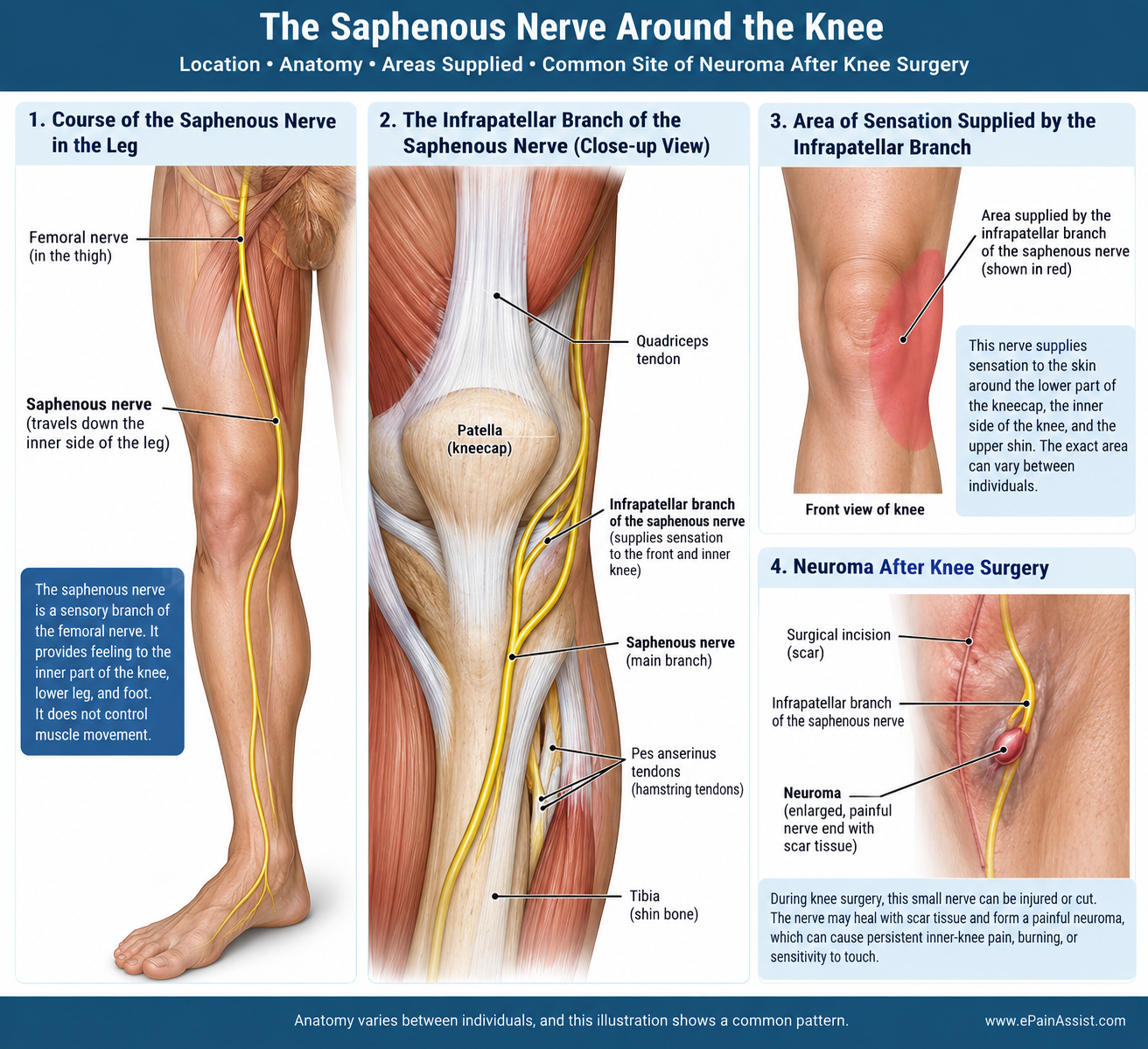
As the saphenous nerve travels down the thigh, it passes through an area known as the adductor canal. Around the knee, it gives off several branches. One of the most clinically important is the infrapatellar branch of the saphenous nerve.
This small nerve travels across the front and medial aspect of the knee and supplies sensation to skin around the lower patella, upper shin, and anteromedial knee. Its exact path varies considerably from one person to another. Anatomical studies have demonstrated substantial variation in the location and branching pattern of the nerve, meaning there is no single surgical incision that can completely eliminate the possibility of injury. [3,4]
That anatomical variability helps explain why the nerve can become injured during otherwise technically successful knee surgery.
What Is a Medial Saphenous Nerve Neuroma?
A neuroma is not usually a tumor in the traditional sense.
When a peripheral nerve is cut, stretched, compressed, or otherwise significantly injured, the nerve attempts to repair itself. Regenerating nerve fibers normally try to grow toward their original destination. When the normal pathway has been disrupted by surgery, scar tissue, or trauma, however, those nerve fibers may grow in a disorganized fashion.
The result can be a small collection of abnormal nerve tissue known as a traumatic neuroma.
Many nerve injuries produce only numbness or altered sensation and never become significantly painful. A painful neuroma develops when the damaged nerve becomes hypersensitive and repeatedly generates abnormal pain signals.
Around the knee, this can produce persistent focal neuropathic pain despite apparently satisfactory healing of the underlying joint.
Why Can a Saphenous Nerve Neuroma Develop After Knee Surgery?
The infrapatellar branch runs relatively close to the skin and surgical field around the front and inner knee. Because of this superficial position, it can be vulnerable to several forms of injury.
The nerve may be:
- Cut during an incision
- Stretched by surgical positioning or retractors
- Compressed by postoperative scar tissue
- Entrapped within healing tissue
- Irritated by nearby hardware or surgical fixation
- Injured during harvesting of tissue for ligament reconstruction
- Damaged during placement of arthroscopy portals
Injury to the infrapatellar branch of the saphenous nerve has been described following total knee replacement, knee arthroscopy, anterior cruciate ligament reconstruction, meniscus surgery, and other procedures involving the anteromedial knee. [1,5]
Importantly, nerve injury does not automatically mean a painful neuroma will develop. Numbness around a knee incision is relatively common following certain knee operations, particularly knee replacement. Only a portion of patients with sensory nerve injury develop clinically significant neuropathic pain or a symptomatic neuroma. [6]
Saphenous Nerve Neuroma After Total Knee Replacement
One of the most recognized settings for this condition is persistent pain following total knee replacement.
Traditional knee replacement surgery commonly requires an incision along the front of the knee. Small sensory nerve branches may cross the area of the incision and can therefore be divided during surgical exposure.
Research has documented sensory changes in the distribution of the infrapatellar branch following total knee replacement, although most sensory changes do not result in severe chronic pain. [6]
In a smaller subgroup of patients, however, the divided nerve may form a painful neuroma.
This possibility becomes especially important when a patient continues to experience localized medial knee pain after knee replacement despite satisfactory implant positioning and no obvious infection, loosening, instability, or other mechanical explanation.
Recent research has suggested that neuromas may be underrecognized among patients with otherwise unexplained persistent pain following total knee replacement. [7]
What Does Saphenous Nerve Neuroma Pain Feel Like?
The quality of pain is often different from typical arthritis or mechanical knee pain.
Patients may describe:
- Burning pain along the inner knee
- Sharp or stabbing pain near the surgical scar
- Electric-shock sensations
- Tingling or pins-and-needles
- Extreme sensitivity to light touch
- Pain when clothing rubs against the knee
- Pain when kneeling
- Focal tenderness over one small area
- Numbness surrounding an unusually painful spot
- Pain radiating toward the front of the knee or upper inner shin
- A sensation that the skin itself hurts
Some patients can identify one remarkably specific point that triggers the symptoms.
Pressing or tapping this location may cause pain to shoot along the distribution of the nerve. This phenomenon is sometimes referred to as a Tinel sign and can provide an important diagnostic clue. [8]
Pain From Light Touch Can Be an Important Clue
One particularly characteristic feature of neuropathic knee pain is allodynia.
Allodynia means something that should not normally be painful—such as a bedsheet, trouser leg, light finger pressure, or gentle touch—causes significant discomfort.
Hyperesthesia, or unusually intense sensation from normal stimulation, may also occur.
These symptoms point more strongly toward sensory nerve irritation than toward arthritis, ligament injury, or many other structural knee disorders.
Where Is the Pain From an Infrapatellar Saphenous Nerve Neuroma Located?
Pain is often concentrated around the:
- Inner side of the knee
- Lower inner border of the kneecap
- Area immediately beside a surgical incision
- Front-inner portion of the upper shin
- Region between the kneecap and tibial tubercle
However, nerve anatomy varies considerably. The exact painful area therefore differs between patients. [3,4]
This is one reason symptoms do not always fit perfectly into textbook diagrams.
Can a Saphenous Nerve Neuroma Cause Knee Stiffness?
Yes—but usually indirectly.
The infrapatellar branch of the saphenous nerve is a sensory nerve and does not directly control knee muscles. Nevertheless, severe nerve pain can make patients reluctant to bend, straighten, kneel, or load the knee.
Over time, this pain-limited movement may resemble true mechanical stiffness.
A published case described severe knee pain and stiffness following total knee replacement that improved after removal of an infrapatellar saphenous nerve neuroma. The authors referred to this type of pain-related restriction as a potentially reversible form of “pseudoarthrofibrosis.” [9]
This is clinically important because treating the knee as though scar-related joint stiffness were the only problem may not adequately address a painful nerve.
Why Saphenous Nerve Pain Is Sometimes Missed
Persistent pain after knee surgery has a long list of possible causes. Physicians understandably first look for problems involving the joint or surgical reconstruction itself.
Following knee replacement, for example, doctors may need to evaluate for:
- Infection
- Implant loosening
- Instability
- Malalignment
- Abnormal implant rotation
- Patellar tracking problems
- Fracture
- Tendon problems
- Arthrofibrosis
- Bursitis
- Referred pain from the hip or spine
Chronic pain after total knee replacement is often multifactorial, and localized nerve injury is only one possible explanation. [10]
Because nerve-related pain may not appear on ordinary X-rays, patients can sometimes go through repeated imaging studies without discovering why a particular part of the knee remains exquisitely painful.
The diagnosis becomes more likely when mechanical and infectious causes have been investigated and the patient has focal, neuropathic pain in the anatomical distribution of the saphenous nerve.
How Is a Medial Saphenous Nerve Neuroma Diagnosed?
There is no single test that diagnoses every case. Instead, physicians usually combine the patient’s history, physical examination, imaging when appropriate, and response to a diagnostic injection.
Medical History
A doctor will want to know:
- Where the pain is located
- Whether the pain began after surgery
- Whether there is numbness or tingling
- What type of surgery was performed
- Whether touching the skin triggers pain
- Whether symptoms radiate along the inner knee or leg
- Whether the pain feels burning, shooting, or electric
- Whether movement or weight-bearing changes the pain
The relationship between symptoms and the surgical scar may provide another clue.
Physical Examination
During examination, the physician may gently palpate along the expected course of the saphenous nerve and infrapatellar branch.
A highly localized tender point with radiating nerve pain is particularly suggestive.
A positive Tinel sign—where tapping over the injured nerve reproduces tingling or shooting pain—has been used as part of the clinical diagnosis in patients with painful infrapatellar saphenous nerve neuromas. [8]
Ultrasound
High-resolution musculoskeletal ultrasound can be particularly useful because the nerve is superficial.
Ultrasound may help a physician identify:
- Localized enlargement of the nerve
- Neuroma formation
- Nerve entrapment
- Scar tissue surrounding the nerve
- Abnormal relationships between the nerve and nearby structures
Ultrasound can also guide diagnostic or therapeutic injections directly around the suspected nerve. [1,11]
Diagnostic Saphenous Nerve Block
A diagnostic nerve block can be one of the most useful steps when the diagnosis remains uncertain.
A physician injects a small amount of local anesthetic near the suspected nerve.
If the patient’s characteristic pain improves substantially for the duration of the anesthetic, it provides evidence that the nerve is contributing to the pain.
Diagnostic local anesthetic blocks are commonly used when considering more definitive nerve treatment and appear particularly valuable in selecting patients for surgical treatment. [8,12]
Saphenous Nerve Neuroma Versus Other Causes of Inner-Knee Pain
Not every case of medial knee pain after surgery comes from a nerve.
Several conditions can produce discomfort in a similar region.
Pes Anserine Bursitis
Pes anserine bursitis commonly causes tenderness along the inner upper shin below the knee joint. The pain is generally more aching or activity-related than electric or burning. Extreme skin sensitivity and tingling are less typical.
Medial Meniscus Problems
A medial meniscus tear usually produces pain around the medial joint line and may be associated with catching, locking, twisting pain, or swelling. Neuroma pain is more likely to be superficial, burning, hypersensitive, and reproducible by touching a particular point.
Medial Collateral Ligament Injury
Medial collateral ligament problems may cause tenderness along the ligament and pain with stress placed across the knee. They do not typically cause a localized electric shock when the skin is touched.
Lumbar Radiculopathy
A pinched nerve in the lower back can produce pain, tingling, or numbness extending into the leg. However, the distribution is usually broader, and symptoms may be accompanied by back pain, weakness, altered reflexes, or other neurological findings.
Complex Regional Pain Syndrome
Complex regional pain syndrome may produce severe burning pain and hypersensitivity after surgery or injury. However, symptoms are generally more widespread and may include abnormal swelling, temperature changes, skin color changes, sweating changes, and movement impairment.
Correctly distinguishing these conditions matters because their treatments can be very different.
Treatment for Medial Saphenous Nerve Neuroma After Knee Surgery
Treatment depends on the severity of the symptoms, duration of pain, underlying nerve abnormality, previous treatment, and how strongly diagnostic testing implicates the saphenous nerve.
Activity Modification and Desensitization
For milder nerve irritation, treatment may initially focus on reducing repetitive pressure over the painful area. Physical or occupational therapy may include gentle desensitization techniques designed to reduce excessive sensitivity of the affected skin. Maintaining knee motion is also important because guarding the knee because of pain can contribute to stiffness and functional decline.
Medications for Neuropathic Pain
When symptoms have a clear neuropathic quality, physicians may consider medications used for nerve pain rather than relying solely on conventional anti-inflammatory medication. Depending on the patient’s medical history, treatment may include medications such as gabapentin, pregabalin, duloxetine, or other agents used in neuropathic pain management. These medications treat abnormal pain signaling rather than removing the neuroma itself, and they are not appropriate for everyone. Medication selection should therefore be individualized by a physician.
Ultrasound-Guided Injection
Ultrasound-guided treatment allows medication to be placed accurately around the irritated nerve. Local anesthetic, sometimes combined with corticosteroid or other interventional techniques, may provide relief in selected patients. Small clinical studies have reported improvement in patients with infrapatellar saphenous neuralgia following ultrasound-guided local treatment. [11]
Hydrodissection
When scar tissue appears to be trapping the nerve, an ultrasound-guided technique called hydrodissection may sometimes be considered. Fluid is carefully injected around the nerve in an attempt to separate it from surrounding scarred or adherent tissue. This is different from surgically removing a neuroma and is generally considered an interventional treatment for selected cases of nerve entrapment or neuritis.
Radiofrequency and Cryoablation
For persistent pain that responds to diagnostic nerve blocks but returns, some pain specialists may consider procedures aimed at interrupting pain transmission through the affected sensory nerve.
Options described in the literature include:
- Radiofrequency treatment
- Cryoablation
- Other targeted denervation techniques
Because these procedures intentionally modify sensory nerve signaling, careful patient selection and accurate identification of the painful nerve are important. [13]
Peripheral Nerve Stimulation
Peripheral nerve stimulation is another option that may be considered for selected cases of refractory neuropathic knee pain. A small electrical stimulation system is positioned near the targeted peripheral nerve to modify pain signaling. This treatment is generally reserved for persistent cases after more conservative options have failed and requires assessment by an appropriately trained pain specialist.
Surgery for a Painful Saphenous Nerve Neuroma
When pain is severe, persistent, clearly localized to a neuroma, and non-surgical treatment has failed, surgical treatment may be considered. The procedure may involve identifying the abnormal nerve segment, removing the painful neuroma, and managing the remaining nerve end in a way intended to reduce recurrent irritation.
In a series of patients with chronic painful infrapatellar saphenous nerve neuromas following surgery or trauma, surgical treatment produced meaningful improvement in many appropriately selected patients. [5]
Another study involving patients with persistent medial knee pain caused by infrapatellar saphenous neuroma after total knee replacement found substantial pain improvement after neuroma excision. The diagnosis in those patients included both a positive Tinel sign and pain relief following selective local anesthetic nerve block. [8]
A more recent systematic review and meta-analysis also found substantial improvement in pain following selective neurectomy for infrapatellar pain syndrome, although the available evidence largely consists of retrospective observational studies rather than large randomized trials. [12]
Surgery is therefore not automatically appropriate for every patient with medial knee pain. The key is demonstrating that the targeted nerve is genuinely responsible for the symptoms.
What Happens If a Saphenous Nerve Neuroma Is Left Untreated?
The course varies.
Some minor nerve injuries gradually become less noticeable as the nervous system adapts. Others remain stable without causing major functional limitations.
A painful neuroma, however, may continue generating abnormal nerve signals for months or years.
Patients may begin avoiding kneeling, exercise, prolonged walking, certain clothing, or even touching the affected knee. Chronic guarding can then contribute to reduced movement and loss of confidence in the operated leg.
Persistent unexplained pain may also lead to repeated tests or even consideration of additional joint surgery when the original joint reconstruction is not actually the source of the symptoms.
For that reason, identifying the true pain generator is particularly important before another major knee procedure is performed.
When Should Persistent Pain After Knee Surgery Be Evaluated?
Some discomfort, swelling, numbness, and altered skin sensation can occur during normal recovery after knee surgery. However, medical evaluation is appropriate when pain:
- Persists longer than expected
- Becomes progressively worse
- Is strongly burning, shooting, or electrical
- Is triggered by very light touch
- Is concentrated around one small point near the surgical scar
- Is associated with persistent numbness or tingling
- Continues despite otherwise satisfactory knee healing
- Prevents rehabilitation or normal knee movement
Neuroma should not simply be assumed. Infection, blood clots, fractures, implant problems, and other complications may require evaluation depending on the type of surgery and symptoms.
Urgent medical attention is particularly important for significant calf swelling or pain, chest pain, shortness of breath, fever, drainage from the surgical wound, rapidly increasing redness, or severe unexplained swelling.
Can Saphenous Nerve Neuroma Be Prevented During Knee Surgery?
Completely eliminating the risk is difficult.
Anatomical studies have shown that the infrapatellar branch of the saphenous nerve varies considerably between individuals, and investigators have not identified a universal surgical “safe zone” that guarantees avoidance of the nerve. [3,4]
Surgeons nevertheless use anatomical knowledge, careful tissue handling, appropriate incision planning, and meticulous surgical technique to minimize unnecessary nerve injury whenever possible.
It is also important to understand that numbness around an incision does not necessarily indicate a surgical complication requiring treatment. Small superficial sensory nerves may be affected during necessary surgical exposure without producing meaningful long-term problems.
The concern becomes greater when nerve injury produces persistent neuropathic pain rather than an uncomplicated patch of numb skin.
Persistent Inner-Knee Pain After Surgery Should Not Always Be Blamed on the Joint
A knee can be mechanically stable and still hurt.
That is one of the most important lessons in patients with persistent pain following otherwise successful knee surgery.
If the pain is highly localized, burning, electric, associated with numbness or tingling, and unusually sensitive to touch—especially near the inner knee or surgical scar—the saphenous nerve and its infrapatellar branch deserve consideration.
Diagnosis requires more than simply finding tenderness. The physician must evaluate competing causes of postoperative knee pain, examine the sensory nerve distribution, and sometimes use ultrasound or a diagnostic nerve block to confirm that the nerve is responsible.
Once correctly identified, treatment may range from desensitization and medication to ultrasound-guided procedures, targeted nerve treatments, or surgical neuroma excision.
For patients who have spent months wondering why their knee still hurts despite reassuring scans and apparently successful surgery, recognizing a medial saphenous nerve neuroma can sometimes provide the missing explanation.
- Boyle J, Eason A, Hartnett N, Marks P. Infrapatellar branch of the saphenous nerve: A review. Journal of Medical Imaging and Radiation Oncology. 2021;65(2):195-200. doi:10.1111/1754-9485.13141.
- Peng MSJ, et al. Infrapatellar branch of saphenous nerve: from anatomy, sonoanatomy to its clinical implications. Regional Anesthesia and Pain Medicine. 2026. doi:10.1136/rapm-2025-106383.
- Kerver ALA, et al. The surgical anatomy of the infrapatellar branch of the saphenous nerve in relation to incisions for anteromedial knee surgery. Journal of Bone and Joint Surgery. 2013. doi:10.2106/JBJS.L.01297.
- Anatomical Study of the Infrapatellar Branch of the Saphenous Nerve in Humans. Revista Brasileira de Ortopedia. Available through PubMed Central.
- Regev GJ, et al. Management of chronic knee pain caused by postsurgical or posttraumatic neuroma of the infrapatellar branch of the saphenous nerve. Journal of Orthopaedic Surgery and Research. 2021;16. PMID: 34289862.
- Fate of the infrapatellar branch of the saphenous nerve post total knee arthroplasty. Knee. PMID: 16174002.
- Neuromas and Persistent Postoperative Pain Following Total Knee Arthroplasty. Journal of the American Academy of Orthopaedic Surgeons. 2025. PMID: 40600805.
- Chalidis B, et al. Surgical treatment outcome of painful traumatic neuroma of the infrapatellar branch of the saphenous nerve during total knee arthroplasty. World Journal of Orthopedics. 2021/2022. PMID: 35036343.
- Ilfeld BM, et al. Neuroma of the infrapatellar branch of the saphenous nerve: a cause of reversible knee stiffness after total knee arthroplasty. Journal of Arthroplasty. 2008. doi:10.1016/j.arth.2007.07.019.
- Wylde V, et al. Chronic pain after total knee arthroplasty. EFORT Open Reviews. 2018;3:461-470. doi:10.1302/2058-5241.3.180004.
- Clendenen S, et al. Infrapatellar saphenous neuralgia after total knee arthroplasty can be improved with ultrasound-guided local treatments. Clinical Orthopaedics and Related Research. 2015.
- Selective neurectomy as surgical treatment for infrapatellar pain syndrome: A systematic review and meta-analysis. PubMed PMID: 42176450.
- Infrapatellar Branch of the Saphenous Nerve: Therapeutic Approaches to Chronic Knee Pain. Current Pain and Headache Reports. 2024. PMID: 38294640.